Chin and facial hair in women is more common than many people realize. A few stray hairs on the chin, upper lip, cheeks or jawline can be completely normal especially with age, genetics or hormonal changes. But when the hair becomes darker, thicker, more frequent or starts growing on the chin and neck, it can feel confusing and frustrating.
Many women search for answers using phrases such as “chin hair women,” “female chin hair,” “hair on a woman’s chin,” “hair growing on chin and neck female,” “hormonal imbalance chin hair,” or “PCOS chin hair.” These searches often come from the same concern: why is this happening and what is the best way to remove facial hair safely?
This guide explains the most common causes of chin hair and facial hair in women, when it may be related to PCOS or hormonal imbalance and how different facial hair removal methods compare — including waxing, threading, electric facial hair removers, at-home IPL, laser hair removal and electrolysis.
Is Chin Hair Normal in Women?
Yes, a small amount of chin hair in women can be normal. Many women notice one or two coarse hairs on the chin, jawline or upper lip at some point. These hairs may appear during puberty, after pregnancy, during perimenopause, after menopause, or simply because of genetics.
The face has many hair follicles. Some produce fine, soft vellus hair, often called “peach fuzz.” Others may produce darker terminal hair when influenced by hormones called androgens. Androgens are often thought of as “male hormones,” but women naturally produce them too.
The difference between normal facial hair and medically significant facial hair usually depends on the amount, thickness, pattern and speed of growth. A few random chin hairs may not mean anything serious. But excessive chin hair, hair on the female chin that keeps increasing or hair growing on the chin and neck in a male-pattern distribution may be a sign of hirsutism.
What Is Hirsutism?
Hirsutism is the medical term for excessive growth of coarse, dark hair in women in areas where men typically grow thicker hair. These areas may include the chin, upper lip, jawline, neck, chest, abdomen, back or inner thighs.
Hirsutism is not just “a little facial hair.” It usually refers to terminal hair that is darker, thicker, and more noticeable than normal peach fuzz. It can affect confidence, social comfort, dating, work life and emotional well-being.
Studies commonly estimate that hirsutism affects around 5–10% of reproductive-age women although rates vary by population, ethnicity and diagnostic criteria. In women with polycystic ovary syndrome, also known as PCOS, hirsutism is much more common.
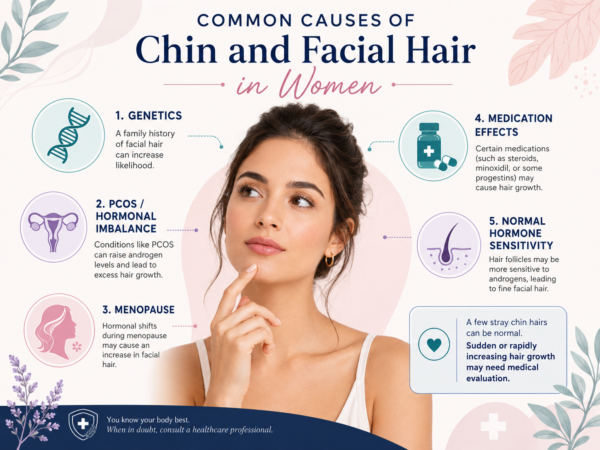
Why Do Women Get Chin Hair?
The most common causes of chin hair and facial hair in women include genetics, normal hormonal changes, PCOS, insulin resistance, menopause, certain medications and rarely, androgen-producing tumors or adrenal disorders.
1. Genetics and family pattern
Some women naturally have more visible facial hair because of family background. Hair color, skin tone, follicle sensitivity and ethnic background can all affect how noticeable facial hair appears. If your mother, grandmother or sisters have chin hair, you may be more likely to have it too.
Genetic facial hair is often stable over time. It may be annoying but it does not always mean there is a medical problem.
2. Normal androgen sensitivity
Even if hormone blood tests are normal, hair follicles may be more sensitive to androgens. This means the hair follicle reacts strongly to normal hormone levels and produces thicker hair. This is sometimes called idiopathic hirsutism when no clear underlying disorder is found.
3. PCOS
PCOS is one of the most common medical causes of female chin hair and excessive facial hair. PCOS can involve irregular periods, high androgen levels, acne, oily skin, scalp hair thinning, weight gain, insulin resistance and difficulty getting pregnant.
Many women with PCOS search for “PCOS facial hair removal,” “PCOS chin hair,” or “best facial hair removal for PCOS” because hair growth may continue even after waxing, shaving or laser sessions.
PCOS-related facial hair often appears on the chin, jawline, upper lip, sideburn area, neck, chest, or lower abdomen. It may grow back quickly after removal because the hormonal trigger remains active.
4. Menopause and perimenopause
Chin hair for women often becomes more noticeable around perimenopause or menopause. As estrogen levels decline, the balance between estrogen and androgens may shift. This can make coarse chin hairs more visible even in women who never had a problem earlier in life.
Menopause-related chin hair is usually gradual. But sudden rapid growth should still be checked by a healthcare provider.
You can find a great guide for conjugated estrogens drugs at the fallowing link.
5. Medications
Some medications can contribute to unwanted facial hair. These may include certain anabolic steroids, testosterone products, some hormone treatments, certain seizure medications and other drugs that affect androgen activity.
If facial hair started after a new medication, do not stop the medication on your own. Ask your doctor whether it could be related.
6. Rare hormonal disorders
Less commonly, sudden or severe facial hair growth can be linked to adrenal gland disorders, ovarian tumors, Cushing syndrome, congenital adrenal hyperplasia or other endocrine problems.
These are less common than PCOS or genetics but they matter because rapid changes may need medical evaluation.
When Chin Hair May Be a Sign of Hormonal Imbalance?
Hormonal imbalance chin hair is more likely when facial hair is new, increasing quickly or appears with other symptoms.
See a doctor if chin hair is accompanied by:
- Irregular or missed periods
- Severe acne
- Oily skin
- Weight gain that is hard to control
- Scalp hair thinning
- Deepening voice
- Increased muscle mass without trying
- New hair on chest, abdomen, or back
- Infertility or difficulty getting pregnant
- Sudden rapid hair growth
- Pelvic pain
- Very high testosterone on blood tests
A few chin hairs alone may not be urgent. But rapid-onset hirsutism, especially with virilization signs such as a deeper voice or sudden severe acne, should be evaluated promptly.
Statistics: How Common Is Facial Hair in Women?
Facial hair in women is common but the reason matters.
Key statistics:
- Hirsutism is commonly estimated to affect around 5–10% of reproductive-age women.
- Some studies report hirsutism in about 4–11% of women in the general population.
- In women with PCOS, hirsutism is reported much more often, with estimates commonly around 65–80%.
- PCOS affects a significant percentage of reproductive-age women, with major health organizations often reporting estimates around 10–13%.
- Laser hair removal and other light-based treatments are among the most popular non-surgical cosmetic procedures but they do not treat the hormonal cause of facial hair.
These numbers explain why female facial hair removal is such a common search topic. Many women are not dealing with a rare problem. They are dealing with a common issue that can be cosmetic, hormonal or both.
The Best Way to Remove Chin Hair: Temporary vs Long-Term Options
The best way to remove chin hair depends on the hair type, skin tone, budget, pain tolerance, medical cause and desired result.
Some women want quick daily control. Others want permanent facial hair removal. Some want facial hair removal at home, while others search for “facial hair removal near me,” “laser facial hair removal near me,” “electrolysis facial hair removal near me,” or “women’s facial hair removal near me.”
Here is how the main options compare.
Shaving and Electric Facial Hair Removers
Shaving is one of the simplest ways to remove facial hair. It does not make hair grow back thicker although the blunt cut tip may feel stubbly as it grows out.
Electric facial hair remover devices are popular for peach fuzz and light facial hair. Searches such as “flawless facial hair remover,” “finishing touch flawless facial hair remover,” “facial flawless hair remover,” “flawless finishing touch facial hair remover,” and “ladies facial hair remover” usually refer to small battery-powered facial shavers.
These devices can be useful for quick maintenance, especially for fine upper lip hair, cheek fuzz or occasional chin hair.
Pros:
- Quick and painless
- Easy to use at home
- Affordable
- No appointment needed
- Good for fine facial hair
Cons:
- Not permanent
- May need frequent use
- Can cause irritation if overused
- Not ideal for very coarse hair if stubble bothers you
Best for: women who want fast, simple facial hair removal at home and are comfortable repeating it regularly.
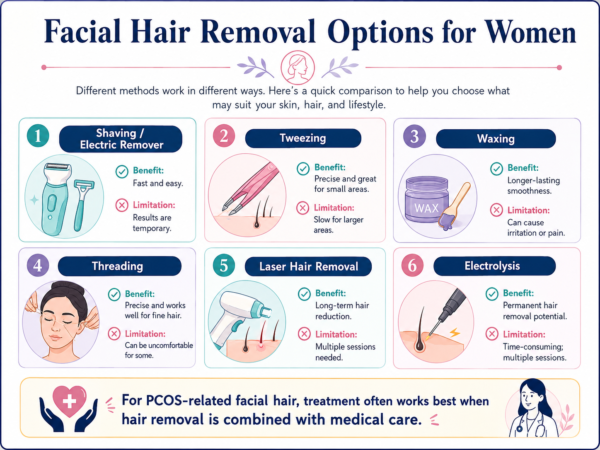
Tweezing
Tweezing is common for a few isolated chin hairs. It removes the hair from the root, so results last longer than shaving.
Pros:
- Good for one or two hairs
- Cheap
- Easy to do at home
- Results may last days to weeks
Cons:
- Time-consuming for many hairs
- Can cause ingrown hairs
- May irritate skin
- Not ideal for large areas
- Repeated plucking may inflame follicles
Best for: occasional stray chin hair not widespread chin and neck hair removal.
Facial Waxing
Facial waxing removes hair from the root and can be done at a salon or at home. People often search for “facial waxing near me,” “best facial waxing near me,” “facial waxing near me now,” “facial and waxing near me,” or “facial waxing at home.”
Waxing can work well for upper lip, chin, cheek and jawline hair but it may irritate sensitive skin. It can also worsen redness or hyperpigmentation in some people, especially if the skin is already inflamed or if the wax is too hot.
Pros:
- Removes multiple hairs quickly
- Results last longer than shaving
- Good for upper lip and chin areas
- Widely available
Cons:
- Can be painful
- May cause redness, burns, bumps or ingrown hairs
- Not suitable right after retinoids, peels or certain acne treatments
- Not permanent
- May worsen irritation in acne-prone skin
Best for: women who want smooth skin for a few weeks and tolerate waxing well.
Threading
Threading uses twisted thread to pull hair from the root. It is often used on eyebrows, upper lip, chin and sides of the face. Many people search for “threading facial hair removal near me” when they want a salon-based option without wax.
Pros:
- No wax or chemicals
- Precise
- Good for small facial areas
- Results can last longer than shaving
Cons:
- Can be uncomfortable
- May cause redness or bumps
- Not permanent
- Skill depends on provider
Best for: upper lip, chin, eyebrows and people who react badly to wax.
Depilatory Creams
Depilatory creams dissolve hair at the skin surface. Some are formulated for facial use but they can irritate sensitive skin. Never use body hair removal cream on the face unless the label says it is safe for facial skin.
Pros:
- Easy at home
- No shaving blade
- Smooth result
Cons:
- Chemical irritation is possible
- Strong smell
- Not permanent
- Not ideal for very sensitive skin
- Patch testing is important
Best for: women who tolerate depilatory products and want a short-term option.
Natural Facial Hair Removal: What Works and What Does Not?
Many people search for natural facial hair removal, remove unwanted facial hair permanently at home or best way to remove facial hair permanently at home. It is important to be realistic.
There is no proven natural home remedy that permanently destroys facial hair follicles. Sugar waxing, turmeric masks, papaya paste and homemade scrubs may make skin feel smoother or remove very fine hair temporarily but they do not permanently remove chin hair.
Be careful with harsh natural ingredients. Lemon juice, baking soda, toothpaste, vinegar and abrasive scrubs can irritate facial skin and cause burns, redness, or dark marks.
Natural methods may help with gentle exfoliation or temporary hair removal but they should not be presented as permanent facial hair removal.
Laser Hair Removal for Chin and Face
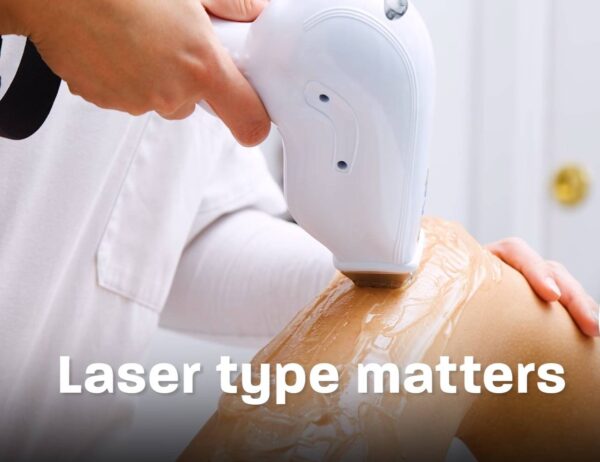
Laser hair removal is one of the most popular options for long-term reduction of facial hair. Search phrases such as “facial laser hair removal,” “laser hair removal chin,” “laser hair removal female chin,” “laser facial hair removal for women,” “female facial hair removal laser,” “chin area laser hair removal,” “laser hair removal under chin,” “chin and neck laser hair removal,” and “chin and lip laser hair removal” all point to the same growing interest.
Laser hair removal uses light energy to target pigment in the hair follicle. It works best on dark hair because the laser is attracted to melanin. It is usually less effective on blonde, white, gray, or very light red hair.
For women with PCOS, laser can reduce hair density and thickness but it does not cure the hormonal cause. New hair can continue to appear if androgen activity remains high. This is why PCOS facial hair removal often requires a combined plan: medical management plus laser or electrolysis.
Pros:
- Long-term hair reduction
- Faster than electrolysis for larger areas
- Good for dark coarse chin hair
- Can reduce ingrown hairs
- Professional treatments are widely available
Cons:
- Not usually one-and-done
- Multiple sessions are needed
- Maintenance sessions may be needed
- Less effective for light, gray, or white hair
- Results depend on device, provider skill, skin tone, and hair color
- Can cause burns or pigmentation changes if performed improperly
Best for: dark chin hair, jawline hair, upper lip hair and women who want long-term reduction rather than daily removal.
Face Laser Hair Removal Cost
Face laser hair removal cost varies by country, clinic, provider, technology and treatment area. Smaller areas such as the upper lip or chin usually cost less per session than a full face.
Searches such as “face laser hair removal cost,” “face laser hair removal price,” “facial hair removal laser treatment cost,” “facial hair removal cost laser,” “laser hair removal chin cost,” “face laser hair removal price near me,” “cost for laser facial hair removal,” and “average cost of laser hair removal on face” show that cost is one of the biggest concerns.
In the United States, national cosmetic procedure averages can be several hundred dollars per treatment category but chin-only sessions at local clinics may be priced differently. The final cost depends on the number of sessions. Many people need 6 or more sessions, and hormonal facial hair may need maintenance.
A useful way to estimate total cost is:
Total cost = price per session × number of sessions + maintenance treatments
Questions to ask before booking:
- Is the quoted price for chin only, upper lip only, full face, or chin and neck?
- How many sessions are typically needed?
- What laser device is used?
- Is the provider experienced with your skin tone?
- Are touch-ups included?
- What happens if your hair is light, gray, or red?
- Is there a patch test?
At-Home IPL and At-Home Facial Hair Removal Laser
At-home devices are popular because professional treatments can be expensive. Search terms include “at home laser hair removal chin,” “best at home laser hair removal for chin,” “at home facial hair removal laser,” “IPL facial hair removal,” “best IPL facial hair removal,” and “IPL facial hair removal at home.”
Most at-home devices are IPL, meaning intense pulsed light rather than true medical laser. They may reduce hair growth over time, especially on light skin with dark hair but results are usually more modest than professional laser.
Pros:
- Convenient
- Can be cheaper over time
- Useful for maintenance
- Private and flexible
Cons:
- Not truly permanent for most users
- Takes consistency
- Not suitable for all skin tones or hair colors
- Can irritate skin if used incorrectly
- Eye protection and correct settings matter
- Should not be used near eyes or on unsafe areas
Best for: selected users with appropriate skin and hair color who want gradual reduction and understand the limits.
Electrolysis Facial Hair Removal
Electrolysis is often considered the most permanent facial hair removal method because it treats individual follicles with electrical energy. It can work on all hair colors, including blonde, gray, white and red hair, because it does not rely on pigment the same way laser does.
Searches such as “electrolysis facial hair removal,” “electrolysis facial hair removal near me,” “chin electrolysis cost,” “electrolysis chin cost,” “electrolysis for chin hair cost,” and “electrolysis chin hair removal cost” are common among women who want permanent facial hair removal.
Pros:
- Can be permanent
- Works on all hair colors
- Works on many skin tones
- Good for small areas like chin and upper lip
- Useful when laser is not effective
Cons:
- Slow because each follicle is treated individually
- Multiple sessions are needed
- Can be painful
- Cost adds up over time
- Provider skill matters
- Possible redness, swelling, scabbing, or scarring if done poorly
Best for: stubborn chin hair, light-colored hair, gray hair, PCOS-related remaining hairs after laser and women who want the most permanent approach.
Laser vs Electrolysis for Chin Hair
Both laser and electrolysis can be useful but they are not the same.
| Feature | Laser Hair Removal | Electrolysis |
|---|---|---|
| Best for | Dark hair, larger facial areas | Individual hairs, all hair colors |
| Result | Long-term reduction | Permanent hair removal potential |
| Speed | Faster sessions | Slower, hair-by-hair |
| Works on white/gray hair? | Usually no | Yes |
| PCOS use | Helpful but may need maintenance | Good for persistent individual hairs |
| Cost pattern | Per session/area | Often by time/session |
| Pain level | Mild to moderate | Mild to strong, varies |
For many women, the best plan is not either/or. A common strategy is laser for dark dense facial hair, then electrolysis for remaining stubborn hairs.
Medical Treatment for PCOS Facial Hair
Hair removal treats the visible hair but medical treatment may be needed if the cause is hormonal. PCOS facial hair removal often works better when paired with treatment that lowers androgen activity or reduces the effect of androgens on the hair follicle.
Medical options may include:
- Combined hormonal birth control pills
- Anti-androgen medications such as spironolactone
- Insulin resistance management
- Weight management when relevant
- Eflornithine cream to slow facial hair growth
- Treatment of underlying endocrine disorders
These treatments require medical supervision. Anti-androgen medications are not suitable for everyone and may be unsafe during pregnancy.
Can You Remove Facial Hair Permanently at Home?
Many people search for “remove unwanted facial hair permanently at home” or “best way to remove facial hair permanently at home.” The honest answer is that true permanent hair removal at home is not realistic for most people.
At-home shaving, waxing, threading, tweezing and depilatory creams are temporary. At-home IPL may reduce growth but it usually does not guarantee permanent removal. Electrolysis is the closest option for permanent hair removal but it is a professional procedure.
If a product promises permanent facial hair removal at home with no risk, be skeptical.
Choosing the Best Facial Hair Removal for Women
The best facial hair removal for women depends on the goal.
Choose shaving or electric facial hair remover if you want fast, painless maintenance.
Choose waxing or threading if you want smoother skin for longer than shaving and can tolerate some discomfort.
Choose laser hair removal if you have dark facial hair and want long-term reduction.
Choose electrolysis if you want the most permanent option, especially for chin hair, white hair, gray hair, or stubborn hormonal hairs.
Choose medical evaluation if facial hair is increasing, linked to irregular periods, acne, weight gain, or scalp hair thinning.
When to See a Doctor About Female Chin Hair?
You should see a doctor if facial hair is sudden, severe, rapidly worsening or accompanied by other symptoms.
Medical evaluation is especially important if you have:
- Irregular periods
- Missed periods
- Infertility
- Severe acne
- Hair loss on the scalp
- Weight gain with insulin resistance signs
- Dark patches of skin around the neck or underarms
- Deepening voice
- New chest or abdominal hair
- Rapid hair growth over months
- Symptoms after starting medication
A doctor may order blood tests for testosterone, DHEA-S, thyroid function, prolactin or other hormones. They may also check for PCOS, adrenal causes, ovarian causes or medication-related triggers.
Quick Comparison: Facial Hair Removal Options
| Method | Best For | Lasts | Permanent? |
| Shaving | Quick daily control | 1–3 days | No |
| Electric facial remover | Peach fuzz, light facial hair | 1–3 days | No |
| Tweezing | Few chin hairs | Days to weeks | No |
| Waxing | Chin, upper lip, cheeks | 2–4 weeks | No |
| Threading | Upper lip, chin, brows | 2–4 weeks | No |
| Depilatory cream | Short-term smoothness | Several days | No |
| At-home IPL | Gradual reduction | Varies | Usually not permanent |
| Professional laser | Dark coarse hair | Long-term reduction | Not always permanent |
| Electrolysis | Individual hairs, all colors | Long-term/permanent | Yes, when successful |
FAQs About Chin and Facial Hair in Women
1. Why do women get chin hair?
Women can get chin hair because of genetics, normal androgen sensitivity, PCOS, menopause, medications, or hormonal imbalance. A few hairs may be normal but increasing or coarse hair may need evaluation.
2. Is hair on a woman’s chin a sign of PCOS?
It can be, especially if chin hair appears with irregular periods, acne, scalp hair thinning, weight gain or difficulty getting pregnant. But not all chin hair is PCOS.
3. What is the best way to remove chin hair?
For a few hairs, tweezing or an electric facial hair remover may be enough. For long-term reduction, laser hair removal may help dark hair. For permanent removal, electrolysis is often the best option.
4. Does shaving make female facial hair grow thicker?
No. Shaving does not change the follicle or make hair grow thicker. It may feel sharper when it grows back because the hair has a blunt tip.
5. Is laser hair removal good for female chin hair?
Yes, laser hair removal can be effective for dark coarse chin hair. But it may not work well on blonde, white, gray or red hair, and PCOS-related hair may need maintenance.
6. How much does laser hair removal chin cost?
Laser hair removal chin cost varies by clinic and location. The total cost depends on the price per session and the number of sessions needed. Chin-only treatments usually cost less than full-face treatments.
7. Is electrolysis better than laser for chin hair?
Electrolysis may be better for permanent removal, white hair, gray hair or stubborn individual hairs. Laser is faster for larger areas with dark hair.
8. Can I permanently remove facial hair at home?
Most at-home methods are temporary. At-home IPL may reduce growth for some people but true permanent facial hair removal usually requires professional electrolysis.
9. What is the best facial hair removal for PCOS?
For PCOS; the best approach often combines medical hormone management with laser or electrolysis. Hair removal alone may not stop new hair from forming.
10. When should I worry about chin hair?
Worry if hair growth is sudden, rapidly increasing, severe or linked with irregular periods, acne, scalp hair loss, deepening voice or other hormonal symptoms.
We wish a healthy and happy life to you. You can find a great guide for Chin Whiskers at the fallowing link.